Monday, 16 July 2012

People Watching (Part 1; first draft)


This is another story for the collection I mentioned last time - it's probably going to have a second part, but I don't know if they'll come together to make one story or if they'll be companion pieces.  It's based, I guess obviously, just on the idea of people watching, and of the weird voyeurism of it, which I guess is similar to any reading experience - you're completely separate from someone, but you still watch them and come to know them and care about them.  It's set on a loose reconstruction (from memory!) of Ballycastle Beach, hence the picture

It's very much a rough-and-ready first draft, so apologies for typos, repetition and just plain rubbishness.  And as ever, opinions and comments very welcome.


It’s sort of snowing, but it’s not quite cold enough, so it’s more like sleet.  It doesn’t lie on the ground in a nice white sheet, but instead clumps in semi-melted puddles which semi-blur into a very shallow semi-lake in the carpark.

If you turn your gaze out to sea (which isn’t pleasant, as there’s a stiff coastal breeze), you’re rewarded with a view which is subtly greyer than the one they put on the postcard.  The sea is stormy, but not as wildly as you might expect, and the waves wash up harmlessly on the long sandy beach which curls away from you to the right, it’s smooth curve broken only by the solitary large rock, which locals will tell you was thrown there in days gone by in a battle of the giants, where the local hero had defeated his rival from behind the headland.  Behind the headland they have a similar but slightly different story, involving a baby cow.

The headland ought to be in sight, but the weather is such that it isn’t even a shadow, as the beach eventually fades into an eerie mist.  It looks completely deserted, but if you look a little closer you’ll see that just beyond the rock there is a figure, swimming in the sea.  He’s too far away to make out clearly, he surely must be youngster to be doing something so ridiculous, or perhaps an old man, who has swam on the beach every day for fifty years, and no winter chill’s stopped him then and it won’t now neither.

Tuesday, 10 July 2012

Short story number two: Elysium (draft)

(This first draft of the second story I've written for a collection that will hopefully be out at the end of Summer.  It's a bit scrappy, but I like putting stuff up as a marker that I've gotten the first draft out of the way.  If you have any feedback feel free to let me know in the comments!)

“Are you alright, Jack?”

Jack glanced up, surprised to be called by name, until a second later he re-noticed the large badge on his chest.  It was the girl who had been sat in front of him for the tutorial.  Jess, he gleaned from staring (not for too long) at her chest.

“Ah I’m fine.  I miss them, you know, but so does everyone else.”

She nodded, smiling a mouth-closed smile.  “Well I do.  I sometimes wonder if I’m the only one though.  People are so good at soldiering on, aren’t they?”

“You’d be surprised.”  The gruff voice came from over Jess’s shoulder; neither of them had seen their tutor approach as his students departed.  Paul.  He would have been old before to Jack’s eyes, middle-aged to a more generous observer, but now in this reshaped society he was positively ancient.  Neither of the youths spoke, flustered that they had been overheard, wondering if they had transgressed.

Monday, 2 July 2012

The Taming of the Shrew at Reading School


Lucia McAnespie (Katherine), David Davies (Petruchio) and Tom Kay (Hortensio)

What could be better than watching Shakespeare performed on the picturesque playing fields of Reading School, with the evening sun gently warming your back and a glass of wine in your hand?  Well, that was a moot point tonight, as the evening began with a desperate plea for the huddled audience to lower their umbrellas, at which point more than one bedraggled spectator decided they had already had enough.

It is thus to the enormous credit of the GB Theatre Company that they managed to perform at all, let alone that they put on such a good show.  On multiple occasions actors slipped, slid and fell on the soaking stage, but each time they managed to see the funny side, as indeed they did with the whole play.  It goes without saying that humour is indispensable in comedy, but where some adaptations of Shakespeare rely on their audience to simply ‘get the jokes’, this production ran the comic gamut from start to finish, from well-staged wordplay to nudging innuendo to those clearly unplanned slapstick falls.

Saturday, 30 June 2012

Review: High Fidelity by Nick Hornby


Widely regarded as an ‘instant classic’ when it came out in 1995, High Fidelity was especially noted for its ability to capture ‘every second of its own present’.  However seventeen years down the line, does it stand the test of time?

In terms of plot, it might have been written at any point.  Rob, a record store owner, has recently split up with girlfriend Laura, and goes through (as one of his ex-girlfriends puts it) ‘some kind of what-does-it-all-mean thing’, with Laura lurking all the while in the background, and Rob himself lurking just outside her house.

Hornby’s writing style also certainly endures.  He ingeniously captures the self-conscious internal monologue of anti-hero Rob, particularly in the virtuoso opening where Rob recounts his ‘all-time, top five most memorable split-ups’: ‘Sometimes I got so bored of trying to touch her breasts that I would try to touch her between her legs, a gesture that had a sort of self-parodying wit about it: it was like trying to borrow a fiver, getting turned down, and asking to borrow fifty quid instead’.

Monday, 25 June 2012

Review: Oriel Ball 2012 - Titanic


It might have lacked Magdalen’s price tag, backdrop and (as we heard midway through the night) fireworks, but Oriel’s Titanic themed ball proved a night to remember.

After the pain of finding a White Tie suit to hire on a night with two balls (note to self: don’t procrastinate so long next time, and don’t use web companies which send it a day late and without a waistcoat… Thanks Hire Society) and the drama of getting ready in time (7.30 seems very early for a night out) we taxied our way past the huge line of Magdalen-goers (with many a top hat in evidence) and arrived at Oriel for a queue of our own.

Thursday, 14 June 2012

Smooth, first draft


[Comments and opinions very welcome!]

She smiled at me, I think.  It was hard to tell, because she might have been smiling already and just happened to glance up and catch my eye, but I think it was for me.

Of course, that wasn’t why I walked over.  I was with Danny, who was meeting Amy, and since the girls’ school broke up at 3.20 and we were in until 3.45 they would always come and wait outside the gates for us to come out.

It was quite a sight actually, with hindsight.  Small groups of heavenly angels (surely they must have been as spotty as us?) would constellate outside the gates, each keeping furtively to themselves, applying make-up and touching up their hair in the grimy and fractured mirror of the vandalised bus stop.

Saturday, 2 June 2012

Smooth - part one


She smiled at me, I think.  It was hard to tell, because she might have been smiling already and just happened to glance up and catch my eye, but I think it was for me.

Of course, that wasn’t why I walked over.  I was with Danny, who was meeting Amy, and since the girls’ school broke up at 3.20 and we were in until 3.45 they would always come and wait outside the gates for us to come out.

It was quite a sight actually, with hindsight.  Small groups of heavenly angels (surely they must have been as spotty as us?) would constellate outside the gates, each keeping furtively to themselves, applying make-up and touching up their hair in the grimy and fractured mirror of the vandalised bus stop.

Sunday, 20 May 2012

Sonnet 1: On pretension


When all is said and done it’s just a word.
And all the time and all the tears you spend
On quotes and notes can only be absurd
When it’s only just one word in the end.
But yet, is’t not in words that dreams are made?
In words young lovers love, and tyrants rage,
And though the men that spoke them, wrote them, fade,
In soft mellifluous prose upon a page,
They die not.  And in our Xbox days
Between the blogs and tweets and likes and shares,
We read, then through their verse and prose and plays
Then we, for one brief breath, are Shakespeare’s heirs
And so, while quotes and notes are vainly nursed,
There’s many words in that so fleeting ‘First’.

Wednesday, 28 March 2012

Review: A Wreath upon the Dead by Briege Duffaud

In amongst the broadly conventionally realist field of Northern Irish fiction, Briege Duffaud's debut novel stands out as a remarkable effort to use the novel form to demonstrate the fractious nature of the Troubles.

Published in 1993, prior to the end of the Troubles, it is perhaps unsurprising the content of the novel is bleak.  A novelist, Maureen Murphy, is attempting to tell the story of a pair of star-crossed lovers from her home town, an effort which is hindered both by the scarcity of evidence and the strong feelings the tale evokes.  Meanwhile the descendants of the original lovers are interacting once more in the context of sectarian violence in Northern Ireland.

However such a cursory plot summary cannot do justice to Duffaud's work.  Told without any detached narrator, the novel intersperses documents (newspaper reports, diaries, sections of Maureen's novel) with stream-of-consciousness style outpourings from a range of characters.  In the original love-story,  set just prior to the Potato Famine, it becomes clear that Maureen's sources are in radical disagreement about just what happened.  Meanwhile in the contemporary story, the half-remembered myths and sectarian biases of the protagonists mean mutual understanding is impossible.

Duffaud's point in writing the novel is clearly that any account of history is partial, particularly in such a strongly divided environment as Northern Ireland.  However by giving voice to such a range of perspectives, without endorsing any of them, Duffaud suggests the means by which peace can come - mutual articulation of contradictory truths.

If the novel succeeds on this radical theoretical level, it simultaneously manages to be a rewarding read, albeit one which is unashamedly challenging.  The historical love story is perfectly balanced, attracting our sympathy while suspending our judgement, while the complicated drama of the modern day tale rings true in a way that a conventional narrative could not.  As noted, the tone tends towards the bleak, but that does not detract from the brilliantly flawed characters who make up this bizarrely fascinating version of Northern Ireland

Saturday, 7 January 2012

New Story

Looking down at his watch, James realised he was going to be late.  7.23, plus five minutes because he still hadn’t gotten round to correcting the time, and he was a definitely more than two minutes away from where he thought the restaurant was.  Bad times.

Striding out of the almost empty shop (why they stayed open until eight on a Thursday was a mystery) he resigned himself to having neither time nor money for a present.  He normally prided himself on his ability to find the perfect gift, and indeed this time last year had probably been his best performance ever.  Of course, it was slightly more difficult to come up with the perfect gift for your ex-girlfriend.

As he fought his way into the icy wind he wondered to himself why he was even bothering to come.  Matt would have told him that it was a hopelessly optimistic attempt to persuade her to take him back, but that wasn’t really true.  Not that he would have said no, he just didn’t hold out any hope that she would give him a chance to.

And to make matters worse, it wasn’t just going to be Lucy, or even just Lucy and her insufferable family.  (“Oh, you study drama?  How lovely!  You know I thought about being unemployed once too…”)  No, this was the first time he was going to be confronted with Nicky.  Lucy and Nicky.  Licky, as Matt had gleefully portmanteaued. 

Only as he turned into East Street did he see the huge grey puddle on the side of the road, and the bus bulldozing towards it.  Clearly his luck was in tonight, he moaned inwardly, bracing himself and turning away from the road.  But the splash didn’t come.  “Great.  Even the bloody bus pities me,” he muttered sullenly.

Still inwardly cursing to himself, James finally made it to the restaurant.  A ridiculously shaped creature glared down at him from above the entrance, its angry red eyes perfectly contrasted with the puerile discoloured tongue.  It would have been funny, except he knew that he would have had to starve for a week to have taken Lucy for a meal here.

Late, he didn’t think to wait before going straight in.  The restaurant had a curious scent of lemon, and the noise coming from round to the left told him the direction he needed to go.  Ignoring the joyless grin of the waiter on the door, he headed to meet his fate.

It astounded him, in the era of Facebook, that there could be so many people around a table and he could know so few of them.  At the head of the table Lucy’s mother was fussing, looking splendidly ridiculous in a supposed-to-be gold dress, while her father stood next to her, glaring at the Chinese lettering on the wall as if certain it was a deeply personal attack on himself, his family and Margaret bloody Thatcher to boot.

The subject of Lucy’s mother’s fussing must be Nicky, James surmised.  Taller than him, thinner than him, with the rolled up sleeves of his prissy pink shirt revealing biceps even bigger than his hard-earned chicken wings.  Lucy’s mother was apparently concerning herself with brushing a stain from just below his left hip.  Get a room.

And there, watching this deeply incestuous act of cleaning, was Lucy.  With a sudden surge of joy he noticed she was wearing the white jumper he had bought her last year, the one he had always teased her made her look like he must be her servant.  It was long and tight, curving round her hips and covering the tops of her skinny jeans, which in turn ran down her long legs to a pair of shiny black heels.  She was talking to her mother, her face twisted into what she always hoped was anger, but to him could only ever be adorable.  He remembered the last good conversation they had had, back on their trip to Dublin, and –

“And who are you then kid?”  The deep Scouse (probably?) voice brought him back to reality.  He tore his eyes away and brought them to rest on a curiously obese man, giving him a not unfriendly look.  James didn’t recognise him.

“I’m – I’m James,” he faltered, dreading what was he had to say next.  “I’m a – a friend of Lucy’s.”

“Oh aye?”  (Was it Scouse?  Now it sounded more like Pirate.)  “From University I supposed?  You Oxford types eh.”

“No, not from Oxford.  I knew her from when we were at school actually.”  And we used to date.  And she told me she loved me before she realised she preferred men whose names and fashion senses suggested they always wondered why they had a Y chromosome.

The man paused, clearly conscious of his mistake, but not troubling himself to look overly guilty about it.  A glimmer of recognition flashed across the man’s eyes.

“Oh, right, James, of course.  Yes well you probably wouldn’t remember me, but I live next door to the Higgins’s, I remember you driving round to see her eight nights a week.  Red Vauxhall Corsa, right?”

James blushed to almost the colour of the car and nodded.  The man smiled sympathetically.

“Well it looks like the only seat left is next to us, so you’re more than welcome to slot in here.  If you don’t want to go give Lucy her present…”

James felt his cheeks burning still darker.  “I didn’t manage to get her anything in the end…”  He hovered momentarily, weighing up whether to go and say hello or not.  He should do, he realised, but wouldn’t it just be awkward for everyone?  And surely she would come over later anyway.  Conscious of the genial Scouse Pirate’s watching gaze, James moved as if to go, swayed back, and finally surrendered into the waiting seat.  The Scouse Pirate smiled knowingly, although he didn’t seem like he was going to share that knowledge with anyone.

“The name’s Eric.  And this is my wife Veronica.”  A still fatter woman on Eric’s left smiled up at him, gesturing that she would say hello but she didn’t want to risk losing one of the prawn crackers in her mouth.  

“You might be wanting this,” said Eric, pouring James a large glass of an expensive-looking Merlot.  James smiled and swigged.  Deeply.

Thursday, 22 December 2011

Charity vs Tax

It seems, at least amongst my friends, that ‘right-wing’ is a dirty word.  Right-wing views stand for backwardness, ignorance, oppression, greed, cynicism, contrasted against the progressive and caring Left.

There are obviously some very good reasons for this.  Right-wing politicians (as a movement, as opposed to in specific cases) want to reduce benefits for the poorest in society, while cutting taxes on those who have the money to pay them: the rich get richer and the poor get poorer, as caricature would have it.

But while this viewpoint is incredibly popular, I honestly believe it also overlooks a powerful idealism that drives those who hold Right-wing, small state economic views.  Idealism is more commonly a charge levelled at the Left in response to their rejection of market economics, but I want to argue that the opposite is true: a real idealist must surely hold right-wing views.  Let me elaborate.

For an opening premise, I would suggest that in a truly ideal world, there would be no police, because there would be no crime.  There would be no Ministry of Defence, because there would be no war.  There would be no welfare, not because there would necessarily be no poverty or disability to make it necessary, but because society would act to support those people without needing to resort to forcibly taxing every member of society to pay for it.

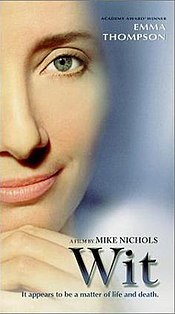
Review: Wit by Mike Nicholls (starring Emma Thompson)

Wit, a 2001 HBO movie starring Emma Thompson, has never really made much of an impression on the viewing public in the UK, if my total ignorance of it is anything to go by.  Having watched it last night, this fact is absolutely mystifying.
To be sure, Wit makes for anything but comfortable viewing.  Depicting the suffering of an English Literature professor diagnosed with ovarian cancer, the setting never departs from the hospital, and the plot, if such a word ought to be used, is minimalist.  For most of the 99 minutes, all the viewer is presented with is Emma Thompson speaking directly to the camera about seventeenth-century poetry.

Despite this (or, perhaps, because of it), what emerges is an astounding dissection of the human mind under stress.  For much of the film I could barely tear my eyes away from the screen, and it was the monologues, not the action, which most inescapably held my gaze.

Monday, 12 December 2011

One Day: A tentative literary analysis

Is literary analysis something that ought to be reserved for a particular type of book?  It’s a significant question, because implicit in it is a questioning of the fundamental purpose of literary analysis.  This is a debate that fascinates me, but rather than exploring it in the abstract, I want to take a work of incredibly popular modern fiction, and subject it to some serious, if tentative, analysis.  The book I want to take is One Day by David Nicholls: it is well on its way to reaching one million sales this year in the UK alone, but simultaneously its original structure provides a entry-point for analysis.

The originality of the book is chiefly found in this unique structure: the book follows the lives of protagonists Emma and Dexter on the same date across 20 years.  Nicholls himself said that he wanted to create the sense of ‘a photo album, so that the characters seem to change, yet remain the same’.  However this snapshot approach is undermined by the fact that (as critical reviewers have pointed out) each chapter tends to begin with each character recounting what has happened in the preceding twelve months.  

A second claim Nicholls makes for his structure is that ‘my initial instinct was to cover landmarks – births, marriages, deaths. Instead, I’ve taken one day at random – like a date on a bank statement’.  This is a radical claim: as early as Tom Jones in the eighteenth century novelists have been conscious of omitting insignificant passages in story; but Nicholls claims to be doing the opposite.  This might be seen to be commenting on the significance of non-momentous events, except it seems that Nicholls is again being disingenuous.  It stretches plausibility that Emma and Dexter not only meet on July 15th, but it also the date on which they fall out, reunite, launch their first prime time show, become romantically involved, not to mention the date that Emma dies.  This is not a criticism of the novel; but it is a dismantling of the claim that the days are chosen ‘at random’.

If the structuring is neither rigorously followed nor realistic, it might be better seen as a system of imposing significance and meaning.  This is clearly a motivation for any narrative: in telling a story we take orderless events and manipulate them into a narrative with causation, and ultimately meaning.  In One Day this meaning comes significantly from the fetishisation of one particular date.  The actual significance of the date changes: initially it is the anniversary of their first meeting, by the end of the novel (in an allusion to Tess of the D’Urbervilles) it has become the anniversary of Emma’s death.  Looking at dates for patterns to signify providence is a pastime of Robinson Crusoe, but in One Day it is not the characters who carry out this work (neither Emma nor Dexter is ever explicitly aware that it is the anniversary of their meeting), but the novel itself which highlights this anniversary and endows it with significance.

However in many ways, what is most significant in the novel is not the date, but the lovers themselves.  One Day is deeply entrenched in the cultural attitude towards romance that two people are ‘meant to be’.  One Day takes the comparatively rare (although by no means unique) approach of dividing attention equally between both lovers: Pride and Prejudice is the story of Elizabeth Bennett with Mr Darcy as her love interest; One Day has no such primacy. 

In contrast to the shared focus on Emma and Dexter, the novel furthers this effect by marginalising all other characters, and particularly romantic interests.  By beginning emphatically with their first meeting and continuing by highlighting both of them, there is never the slightest possibility that Dexter will end up with Sylvie, even when he is in love with her. 

It is striking that the novel indulges in endless counter-factual speculation about Emma and Dexter coming together sooner (what if Dexter had mailed the letter? What if Emma had answered the phone when she was on her first date with Ian?), there is a total absence of comparable exploration of the possibility of them finding love elsewhere.  The sense that is created by all these effects is that Emma and Dexter could only ever end up together – the tragedy of the book is that it takes them both so long to realise this.

Of course, this analysis holds firm for the vast majority of the novel, but the closing chapters offer two distinct twists.  Emma’s death is obviously integral to the meaning of the novel, but it is equally worth considering the fact that Nicholls’ avoids the conventional comic romantic ending by bringing his couple together with five years left to go.  It has been often noted that fiction has endless courting couples but precious few happy marriages: traditional comedy (and modern rom-coms) tend to end with a wedding day.  The two years that Emma and Dexter are married function as a demystification of the ‘happily-ever-after’ myth: their inability to conceive symbolises the ongoing problems in the happiest couples.  Dexter’s conclusion that he is not ‘happyish’ but ‘happy’ is a validation of this lifestyle and of the novel’s premise that the pair are destined to be together, but it is no fairy tale.

Far more significantly, the fairy tale premise is undermined by the sudden death of Emma.  Again, this might conventionally be placed at the very end of the novel, with perhaps the last chapter inserted as an epilogue, but Nicholls resists this temptation in order to consider what happens when a Romeo has to outlive his Juliet.  Dexter, unlike Emma, has been prepared for this by undergoing significant loss twice in the novel; once when his mother dies and once with divorce: neither case ends well.  Thus it is unsurprising when his most significant loss sees him thrown out of a strip club.

Of course, Dexter doesn’t end in self-destructive mode; he ends by taking his daughter to the spot where he spent that first day with Emma.  This artistic symmetry only confirms the sense that he has no life beyond her: he is on holiday with his daughter from a pre-Emma relationship and his post-Emma partner, but his actions are still focused on her.  Partly this is because it is the anniversary of her death, a day on which she would obviously be in his thoughts, but in the structure of the novel every day shares this focus.  Dexter does not end the novel in despair, but he does end it with very little beyond memory to live for.

Thus One Day is both inextricable from and sceptical of the myth of lovers destined to be with one another.  On the one hand there is no possibility in the novel that Emma could have married Ian or Dexter been happy with Sylvie, but on the other there is no possibility that Dexter will ever see Emma again.  ‘Em and Dex’ is at once a mythologized concept (it is hard to finish the book without wondering who your Em/Dex is) and simultaneously extinct.  Fragile but beautiful, One Day’s presentation of love is far more complex than the pop-fiction romantic comedy box in which it has been placed.

Let me know what you think in the comments!

Monday, 29 August 2011

My new novel

So I was working on this just now, its very raw (probably to the point of spelling errors...), but it's the prologue to what might potentially become a novel.  Or not.  We shall see.

It's (hopefully) funny, but also quite dark, and features prolific swearing, but if that doesn't put you off you're clearly bored enough to keep reading, so go on.  Feel free to let me know what you think, even if you don't make it the whole way through.
___________________________________________________________


“Yeah, but I didn’t steal them.  I was just walking down High Street, you know, and then someone came out of the shop, it was this girl, she was like five foot tall, quite chubby, still fit though, and she was carrying this bag, like a handbag, and then she started running and these two guys came out, from security, and they were chasing her, so she suddenly lobbed them at me, and I didn’t even know what it was to be honest, but I caught them, and suddenly these guys were on me, and like they must have seen me catch them cos they were quite close, and one of them tried to deck me but he missed and then they pushed me over and ripped them off me, so I just lay there.  I’m not gonna lie, it was pretty fucking scary, cos I’ve never been in trouble before, and I didn’t want my mum to find out, cos she reckons my girlfriend’s been a bad influence on me and she ain’t, but its not like she believes that… So yeah, I didn’t do it, so like, I don’t even know why I’m here, do you know what I mean?”

The balding, tubby, broad faced cop looked across the table.  For a minute he just stared blankly, with the dead expression of an insomniac watching late night television.  Then his left eyebrow slowly curved itself and climbed his glistening forehead.

“That is literally bollocks.”

His junior partner just barely held back a snort, before almost instantly rearranging his facial features to the mirror image of a concern and responsibility.  Kevin started to open his mouth, but the tubby cop interrupted.

“That is fecking ridiculous.”  (He wasn’t Irish, but like many Englishmen he sometimes forgot that in tense situations.)  “You went into the shop, you picked up the sweets, you shoved it in your pocket, you walked out...”

“…No but you didn’t see that girl…”

“That girl? Of course I didn’t see that girl! Noone outside of the chubby chaser porn you watched this morning before breakfast saw that fecking girl!  You took the ipod…”

“No but they punched me, and that’s definitely not…”

“Punched you? They asked you to stop for a second and you told them you had a fecking gun.”

“Yeah but I didn’t.”

“And I honestly don’t know if that’s because you’re a liar or because you’re genuinely stupid enough to believe it.”

Saturday, 6 August 2011

Why shouldn't we shop at Tesco?

Today's Guardian's Weekend Magazine led on a story about how 'across the country people are battling the relentless march of the 'Big Four''.  Have the four horsemen of the Apocalypse come at last?  Is there a nationwide movement to find 11 footballers good enough to beat Arsenal, Chelsea, Manchester United and Liverpool? No, the Guardian doesn't think we should shop in supermarkets.

The article itself tells a harrowing tale.  According to one banner near a Norfolk village 'TESCO IS A PARASITE - it fastens on to healthy, vibrant market towns and KILLS them'.  Valiant freedom (from supermarkets) fighters in Bristol have damaged an evil new Tesco store so badly that it had to close for a month, but still the monstrosity matches on.  'Once one of the Big Four has a town in its crosshairs, it can usually be assured of eventual success... Once planning permission has been granted and another supermarket goes up, the inevitable happens: local traders suffer, and many go out of business'.

Leaving aside the ridiculous metaphor that suggests big supermarkets want to shoot towns, the biggest problem with this narrative is that it totally overlooks the crucial step in the process.  When Tesco opens in a town local traders do not 'inevitably' suffer and go out of business.  There is no magical corporate voodoo whereby Jerry's Butchers down the road suddenly wakes up to find itself bankrupt.  Instead, shoppers can choose to spend buy their food (or clothes, or life insurance) from the supermarket rather than the small business, and if they do the small business loses income.

The Guardian focuses on the suffering of small business owners in the article, and that is indeed one side of the debate.  However what about the shoppers, who can now save 10% on their food bills across the year, and thus afford to give themselves a holiday?  Or those who previously didn't have time to get the film they wanted to watch that night because they couldn't squeeze in a trip to the DVD shop and the food shop in the small window of time they had free, but now thanks to a late-opening superstore can settle down in front of Titanic and have some dinner too in the bargain.

You might argue that those are small and superficial benefits, and they don't compare to the loss to communities and companies that are the necessary cost of such comforts.  But if the benefits are so small and the damage to the community so great, then why are enough people shopping in supermarkets to keep them running?  If the anti-supermarket campaigners are right and the appearance of Sainsbury's in their town will ruin it, then they need only convince enough people of this truth (which they consider so obvious it is acceptable to cause criminal damage in defence of it) and the new superstore will be choked of custom and move away.

The other side of the equation is that small businesses can save themselves by providing products or services that are more attractive than what Tesco can offer.  Even if they can't compete on price due to economies of scale, there is nothing to stop small businesses going the extra mile to provide superior products or superior customer service.  Residents in these towns can support small businesses not by opposing the arrival of supermarkets and denying choice to those who want it, but by continuing to shop in their local butcher even though they could get a wider range of cheaper meat just down the road.  Unfortunately, the facts would suggest that (in the main) they don't.

And what of the Guardian's other claim against supermarkets, that thanks to the heinous Town and Country Planning Act of 1990 they can 'swing the debate by offering to fund no end of sweeteners: libraries, public spaces, housing, even schools'(!)  How immoral, Tesco unscrupulous sinks small businesses by resorting to such disgusting bribery.

Except, isn't the Guardian angry about closures to libraries, claiming they're a vital service to communities and education?  Aren't we all aware of the great need for housing at the moment, and the corresponding need to ensure there are available public spaces?  Didn't Tesco give over £9 million to schools in the UK last year, providing vital equipment that will only become more important in an era of cuts?  Isn't the whole argument that Tesco comes to areas and destroys communities completely undermined by the fact that the Guardian are claiming that they buy their way to success by investing in precisely the same communities?

Of course it is unfortunate for a very hardworking shop-owner if they close down as a result of losing custom to a supermarket.  But given that supermarkets also provide jobs, produce products that need workers to produce them and form an important part of the communities they find themselves in, it is simply ridiculous to describe Tesco as a sinister parasite.  If you prefer to help local shops then noone is stopping you from doing so.  Just don't try and claim the moral high ground if I'd much rather nip down to Asda.

Monday, 18 July 2011

Review: A Tale of Two Cities

(contains some spoilers)

Prior to this I’ve had mixed feelings about Dickens.  Bleak House is a fantastic book, with a brilliant cast of characters, targeted and effective satire and an extraordinarily complicated plot that all comes together for an excellent finish.  Little Dorrit is similar, but crumbles at the end, and the characters never quite reach Bleak House levels.  Oliver Twist was ok, but the plot was a little too contrived, and Nancy aside the characters fell on just the wrong side of caricature.  Great Expectations I hated, mainly because of a deep-seated loathing of Pip, and the ridiculous incredulity of Magwitch as a character.  With the decision of who to study as a ‘Special Author’ next year looming, A Tale of Two Cities was given the make-or-break position in my Dickensian life.

Luckily for Dickens (I like to think he has a particular posthumous interest in whether he is studied by undergraduates, and consequently has a fierce ongoing ghostly war with Virginia Woolf…), the novel is outstanding.  It uses its historical setting (the French Revolution) to just the right extent: it creates an epic backdrop to the action, but never in a way that seems forced.  The emotional tone is excellent, and the story is such that I stayed up until 2am finishing it.

To start with an area where Dickens is often brilliant but sometimes dull, the characters of the tale are a particular highlight.  Typically many of them are unashamedly two dimensional: the deeply evil Marquis St. Evrémonde, the dutiful and sarcastic Miss Pross (although she has a potential sapphic element…), the amusingly pompous Mr Stryver.  However all of these fit into the story very successfully, providing just the right amount of humour to what is (for Dickens) a comparatively serious novel.  The romantic leads Lucie and Charles are similarly conventional; however they provide a narrative centre for the story to revolve around.

These characters are fine; however the novel thrives on a core of far more impressive literary creations.  The Defarges shift from supportive positive characters to terrifying antagonists in a manner that is totally credible, and illustrates the power of the civil war to make villains of otherwise ordinary men.  This gives them far more credibility than Dickens’ numerous motivelessly evil characters such as Oliver Twist’s Monks and Bill Sykes.  The message here is that the movements of history can move anyone towards evil, a far more complicated a frightening idea than simply the presence of ‘bad guys’.  This fickleness of the fates and its relationship with people is typified by the caricatures of the mob, willing to release a prisoner mercifully and then bay for his blood in the space of 24 hours.

Better even than the Defarges is the character of Sydney Carton, who makes a similarly dramatic movement from minor character to Christ-like hero.  His mysterious origins are never really explained; the novel seemed set up perfectly for the final act ‘twist’ to be that Carton was a long lost relative of Darnay (as in Jane Eyre, Daniel Deronda, Oliver Twist, Bleak House… the list could continue).  Fortunately Dickens rejects this convention and finds a twist that is far more powerful.  By giving the novel’s defining role to such a figure the centrality of the two lovers is comprehensively undermined: we are prompted to look past Romeo and Juliet to see those who suffer to make such pleasant ordinariness even possible.

The Carton twist is not the only highlight of a narrative that manages to remain credible in spite of its coincidences.  As the novel draws towards its conclusion the elements fit perfectly into place: Miss Pross gets to demonstrate her heroism and loyalty (filling a role that very much parallels Carton’s); Dr Manette is allowed to reassert his masculinity in a way that is both deliciously constructed and touchingly heartfelt, only to have it snatched away from him again in order to disprove any claims of sentimentality; even Cruncher’s night-time activities are (at least partially) validated.  The long flashback scene is perhaps a weak point; however it provides crucial motivation that brings the plot together in a way that makes complete sense.

Overall then, this is a great success from one of English literature’s acknowledged titans.  It’s hard to find a way to sum it up succinctly as it operates on so many levels.  Carton might steal the show in the finale, but that does not detract from the quiet heroism of Lorry, the wild passion of the Defarges or even the steady love of the Darnays.  The catalyst of the revolution permits these characters to blend in a way that gives a reader a fresh perspective on the impossibility of black and white judgements of that event, and thus it is fitting that Dickens breaks his trend of black and white characters.  The only surprise is that there hasn’t been a TV adaptation since 1989: the cinematic scope and sprawling narrative would surely lend itself to another three or four part series.  And will I be studying Dickens next year?  Most definitely.

Monday, 11 July 2011

Review: Dublin by Edward Rutherfurd


Dublin - Edward Rutherfurd

On one level, Edward Rutherfurd’s Dublin succeeds as a collection of well-executed, if somewhat conventional narratives, linked together slightly tenuously by the inter-generational connections between the characters.  On another level it raises some really challenging questions about how we view history.

First the stories.  The book, like Rutherfurd’s other works, follows an episodic structure.  Each section is set in a different time period of Dublin’s history, from the pre-Christian era through to the Reformation.  The same family’s appear in each episode to give a further sense of continuity, but other than that each episode is almost completely distinct.  As mentioned, the stories themselves rarely depart from very conventional plotlines. We have star-crossed lovers, ongoing mistakenly-held grudges, treachery, smuggling and more.  Each episode is granted only a couple of hundred pages and increasingly they encompass a wide range of characters, so logistical limitations are clearly a factor in the complexity of plotlines.

Nonetheless these simple stories succeed in holding a reader’s attention for over 800 pages.  Partly this is the historical dimension of the novel, however it is equally due to the very successful characterisation that carries on throughout the novel.  Rutherfurd has a gift for creating believable characters in the space of just a few pages, meaning that for all the stories’ simplicity, the reader still feels involved.  This characterisation, as in Rutherfurd’s other works, is especially strong when an episode stretches over many years: the characters which are most sympathetic are those that we see as children, and then follow as their life shapes them into what they become.  In Dublin this tends to be the almost invariably attractive female characters, developing from hopeful adolescents into more worldly women.

The stories are thus strong, but what marks Rutherfurd out has always been the historical dimension to his novels.  Historical fiction is a very common genre at the moment, but Rutherfurd separates himself from his peers by his pan-historical focus on one location.  Here we see the ancient Irish farmstead of Dubh Linn develop into the Viking port of Dyflin, before finally morphing into the English city of Dublin.  If there is one weakness of this novel compared to Rutherfurd’s other works, it is that the story stops 500 years ago: there is no attempt to build continuity up to the present day.  This is resolved by the sequel: Ireland: Awakening, but in doing so obviously leaves this first novel incomplete.

Rutherfurd is especially good at bringing to life genuine historical characters.  At times this can verge on simply name-dropping (in New York one of the characters happens to gratuitously mention he’s met a young English sailor, by the name of Horatio Nelson), however Dublin has the very different task of bringing to life characters of an almost mythological status, in particular St Patrick and Brian Boru.  With the scarce historical evidence for these men’s lives, let alone personalities, Rutherfurd seizes the opportunity to create these characters anew.  St Patrick comes through as one of the few genuinely religious characters in a book (and indeed a country) that is dominated by matters of religion-as-politics, while Boru is rendered incredibly sympathetic, even as he is extrapolated from his historical position as a legendary king.

The most interesting question raised by the novel, and indeed from all historical fiction, is that of the very nature of studying history.  It is almost uncertainly untrue that (SPOILER ALERT) the successful English occupation of Dublin was accomplished due to one Irish girl’s illicit relationship with a treacherous English soldier, and as such that particular episode in the book would have no place in a typical historical textbook.  However it is equally evident that, especially for older periods, it is the experiences of the normal men and women that have totally disappeared from the historical record, leaving only wars and dates and kings.  We like to pretend (at least in history syllabuses) that history is governed by prevailing socio-economic trends.  However in practice those trends consist of the lives of ordinary people that probably had a lot in common with us today. 

If we told the story of our lives we might flatter ourselves into thinking it would make a similar read to a novel such as this: individual characters interacting, making mistakes and living and dying with the consequences.  But in 500 years time, or 1500 years time, will that be what the history textbooks on the turn of the third millennium will focus on?  Just as somewhere in those narratives of ‘battles over dwindling resources’ in a ‘proto-nuclear age’ will be the lives of all of us, and it is this that is captured in any good piece of historical fiction.  Dublin probably didn’t fall because of Fionnula Ui Fergusa, but you never know...

Thursday, 7 July 2011

My Apprentice Predictions - Contains Week 10 Spoilers

With two weeks left to go in The Apprentice, Melody's firing means there are only five candidates left.  While, in all honesty, this series has (as ever) shown almost all those involved to be useless at business; there have still been moments when a shocking glint of talent has appeared in the sea of mediocrity.  There's a strong case for saying some of those who have been fired (Edna, Glenn, Leon) showed more potential than some of those left.  However, with next week's task looking to be fairly engaging (setting up a new fast food chain), and the final consisting at least partly of interviews, who should (and will) go on to win?  If you have an opinion (or disagree angrily with mine) then let me know in the comments, however for me, in reverse order...

#5 Natasha Scribbins

It's genuinely difficult to think of a single task on which Natasha has excelled.  She has been in the boardroom twice (with the beauty treatment and pet food tasks) and in her two tasks as project manager has produced two very suspect victories: first by producing the Lad Mag 'Covered' which ignored their market research and was described as 'vulgar' and 'outdated', and then this week by misunderstanding the task to the point her victory was described as 'hollow' by Lord Sugar, only to be saved by Susan and Jim's sales.  More than the statistics, Natasha hasn't really shown any ability in any key area of business: in sales tasks such as the week in Paris she's been weak, her personality is starting to clash with those around her (and with viewers), and as mentioned her leadership choices have been poor.  She's been out of the boardroom since week 5, but if she's on the losing team next week, expect her to go.

#4 Tom Pellereau


I like Tom.  Lord Sugar likes Tom.  Everyone likes Tom.  He will probably prove to be an exceptional business man, as he clearly has a spark of invention and entrepreneurialism that is lacking from many of the other candidates.  The problem is, in the context of this show, Tom has been useless.  Excepting the Rubbish collection task and the Magazine task, he has lost in every single show, and its difficult to remember anything he contributed to either of those winning teams.  As project manager in France he was appalling, showing no leadership and no control over Melody: yes Melody is difficult to lead; no that can't be an excuse for someone wanting to lead a large company.  He has shown in many tasks that he has good ideas, and you can't fault him for enthusiasm and personality, but at some stage very soon he needs to show he can lead with authority, and I fear that might be beyond him.

#3 Susan Ma


Despite her life persisting in being 'so unfair' and her unfortunate ability to be the most consistently unintentionally hilarious candidate ('Do French people like their children?'), Susan has in fact shown a lot of talent.  Her sales abilities are impressive, she's shown herself to be correct only to be shouted down more often than Tom has, and she's picked up two wins as project manager; admittedly largely thanks to Helen's pitch in Paris and a total absence of opposition in the hotel-buying task.  As was said in the last episode, Susan does seem almost like a bullied child, she does lack the respect of the other candidates (especially Natasha and, until she went, Zoe).  This reflects badly on the bullies, but equally Susan has got to stand up for herself: as with Tom, the inability to manage strong personalities cannot be an excuse any longer.  With this in mind, Susan ideally needs to project-manage and win in next week's task to show her steel, but at age 21 has potentially got as much up-side as any of the other candidates.

#2 Jim Eastwood


Jim certainly seems to polarize reactions: many have attacked him as manipulative and passive aggressive, while others (perhaps manipulated by his passive aggression) are in awe of his patter and the results he often gets.  Love him or hate him, Jim has been instrumental in winning many tasks: this week his sales were picked out by Nick as a 'Tour de Force'; last week his pitch to Asda was risky, but ultimately delivered a huge victory; back in Week 3 his negotiating skill in the hotel-buying task was vital in an £8 victory.   As these demonstrate, sales, pitching and negotiating are all massive strengths for Jim, the question-marks come in his business strategy and leadership.  In the Pet Food task he was instrumental in the poor decisions that lost the task; Vincent was fired just for not bringing Jim back.  Similarly in the one task Jim has led his poor decisions resulted in a loss, although it was his decision (against opposition) to target the elderly, which was widely seen as a good choice.  To attack Jim for being manipulative seems to miss that, far from being a vice of his, it is simply something he does better than anyone else: Jim's skills as a salesman are at their most desperate when they are defending his own performance, even when the evidence isn't there.  We need to see Jim produce something beyond sales in the final task (which, in fairness, he did something towards by being the sole candidate to understand the importance of re-investment in this week's task) or he could be torn apart in the interviews stage, but thus far Jim is very much a contender.

# Helen Milligan 


Picking Helen as the favorite might not be the most exciting choice, but to do otherwise could only be playing a very weak devil's advocate.  Even looking past the fact she has won on every task, she has shown plenty of signs elsewhere that she is a very strong candidate: initially she was a quiet contributor who never attracted complaint from any of her teammates, before coming to the fore in leading successfully in the Rubbish Disposal task and the Biscuit task, as well as her series-defining pitch in Paris to La Redoute.  With all this evidence her victory ought to be a formality, but (almost as if it were scripted...) this week's task threw a spanner in the works: Helen may have been correct to criticise Melody, but showed no business sense whatsoever in her own decisions in the task.  Her coup was more self-serving than any valid attempt to help the team: it has no chance of being successful (and indeed I don't think Helen knew what she would have done if it had been), and only served to amp up the pressure on a struggling Melody.  There have been small cracks elsewhere: her two victories came by £8 and by one pitch-from-Jim, and La Redoute aside she hasn't produced much at the highest level.  Nonetheless with two weeks to go she is very much in the driving seat: if she performs well in next week's task then it would seem foolish for Sir Alan to pick against her.


Tuesday, 5 July 2011

My 10 Favourite Songs You’ve Never Heard Of

As someone who genuinely still thinks ‘Indie’ music is by definition rare and unknown, it’s fun to look at my itunes top played songs and realise that even I have some unknown diamonds in the rough.  The criteria for entry are fairly vague: if the artist has ever had a top 20 song then to be selected a track has to have never been released as a single, if not then it just can’t have reached the top 40.  If you think you can do better, or if any of these choices make you inexplicably angry, then post something in the comments.


A lot of people seem to see Fall Out Boy as a bit of a joke (see most of the band's Urban Dictionary entries, and their later albums have come in for an especially heavy beating.  Perhaps this is unsurprising, when the band made decisions like not releasing this as a single from their final studio album Folie À Deux.  Chock full of the brilliant/terrible lyrics that have always polarised fans/people who want to see them die painfully, this is definitely another marmite song.  However from the catchy-yet-macabre opening ‘If home is where the heart is, then we’re all just fucked’ to the ridiculous-yet-meaningful chorus ‘My mind is a safe / And if I keep it then we all get rich / My body is an orphanage / We take everyone in’, this a song that can both be sung along to in a crowd and pondered at home.


Listening to this song, it’s unsurprising it comes from the soundtrack to a film adaptation of Romeo and Juliet: the melancholic vocals mean that if it isn’t being played over a montage of despairing lovers then you feel honour bound to assemble those around you and form such a montage yourself.   The heart-breaking opening gives way to a slightly incongruously upbeat second half, but the song as a whole understatedly exudes a universally applicable sense of romantic tragedy.  Wow that sentence was depressing.


It seems like a back handed insult to say that Jack Johnson is the perfect music to fall asleep to, but anyone who has heard him will know exactly what that means.  It seems impossible to imagine the man playing a gig, as his music is perfectly designed for softly rippling out of headphones as you lie on a beach at night.  As such, this song about lying on a beach at night brings together form and content in a way most classic poets could only dream of.  The fact the lyrics are all in the past tense save for the loaded ‘The west winds often last too long / And when they calm down, nothing ever feels the same’ means that the song definitely has a sense of nostalgia, but nostalgia is a dish best served with relaxed guitar, soothing vocals and a lullaby.


With current musical trends moving endlessly towards R&B, Brandi Carlile provides a welcome break with some infectiously upbeat indie-country.  The lyrics seem to be detailing a folksy lesbian romance from middle-America, however Carlile says the song was actually written to her niece.  That fits in well with the childlike glee of the song, definitely the catchiest from a generally strong album which also features many growers.


Again it’s mystifying this wasn’t released as a single from The Fratellis first album Costello Music.  The opening manic drumbeat heralds a breakneck pace throughout which only gets quicker, if anything the vocals only slow the song down.  Lyrically the song isn’t the strongest, however the hints towards what make up the ‘mother’s nightmares’ fit in well with the song’s hectic vibe.  It was massively disappointing not to see this performed live in a generally average set at Reading Festival 2008, as the energy of the track would make it perfect for such a stage


This is a controversial entry, as thanks to its appearance in the film ‘P.S. I Love You’ and in a high profile Magners advertising campaign this song has probably been heard by more people than any other on this list, but judging by the tragic absence of any sort of ‘Chart Performance’ section on the song’s Wikipedia page, it seems clear that no one other than me actually went out and bought it.  The uninitiated (including me, prior to five minutes ago) might see much of the song’s power in the assumption this is a timeless Irish tune passed down by the bards for many centuries, sung to Galway Girls for many a year.  Unfortunately, it was in fact written in 2000 by ‘an American singer-songwriter known for his rock and Texas Country as well as his political views’.  Still, as one of the millions of people around the world with dubious Irish heritage, that only makes me love it more.


Seeing this Irish band perform live at Reading Festival last year was a bizarre experience: one of the muddiest weekends of my life was suddenly punctuated by a blonde woman in a full length pink ball gown screaming to her watching crowd (of about 12) to dance.  Marie Junior’s vocals manage to balance softer moments with the soaring chorus that seems designed for far bigger crowds.  The band are still yet to release an album, however if they do this soaring track will certainly be at the heart of it.


It seems something of a tragedy that Imogen Heap’s crazily original (and slightly mental) tune peaked at 125 in the UK chart, whereas Jason Derulo’s derivative ‘Whatcha Say’ which sampled it reached number 3 and went multi-platinum in four countries.  Heap claims the song is about both a painful break-up and George Bush, which makes about as much sense as ‘Hide and seek / Trains and sewing machines / Blood and tears / They were here first’.  Nonetheless the brilliant a capella vocal arrangement (something Heap excels at) gives the song a truly haunting feel, which is perhaps even added to by its ambiguous meaning.


She might be best known for infectious summer pop songs like ‘Pack Up’ and ‘Skinny Genes’, but a quick look at Eliza Doolittle’s Youtube Channel reveals a remarkable range of cover songs.  Of these, by far the most powerful is her stripped back cover of Radiohead’s ‘Creep’.  Almost totally A Capella, Doolittle shows off her voice at its most raw: devoid of any possibility of auto-tune the very successful 23 year-old pop star somehow manages to give real emotion to this anthem for outcasts.  As yet the track can only be seen on Youtube, and it may never get a commercial release, however it certainly emphasises the range of talents that this otherwise generic pop star possesses.


Everyone has songs that pick up emotional resonance because of hearing them at a certain time in their life where it seems a songwriter has perfectly understood what you feel.  A lot of the time you then get over the moment of teen angst that prompted such soppy sentiments, but sometimes the song is powerful enough to stick around long after the memories fade.  This haunting ballad about a dead brother from a totally unknown Toronto-based pop punk band is one of those.  The chorus is generic enough to apply to any situation, but on its own would risk descending into melodrama.  It’s the details in the verses that really make the song stand out: ‘I remember the car you were last seen in / and the games we would play’.  

Wednesday, 1 September 2010

Reading Festival Review - Saturday

A day that featured no less than three outstanding performances from three very different acts, this was almost worth the weekend entry fee in itself. The great thing about Reading is that you can flick from great comedy to music, and this proved it: even missing the likes of Kevin Bridges and Jason Byrne, Frank Turner and Pendulum; there was still more than enough going on on Saturday to keep me thoroughly entertained.

3OH!3 (NME Stage)

Having spent the morning enjoying the sights of Reading town centre, I only made it back to the festival for 3OH!3 at 2.30. It might have been the two times within a minute that I could hit by cups of (thankfully cold) liquid, or the fact it was the first band of the day, but this set really didn’t do it for me. They played the hits and got the crowd jumping, as well as making a 3-0-3 gesture with their hands (you join your thumbs and index fingers in a circle to make the ‘o’ in the middle, and then raise the other fingers to get three on each side. Sneaky eh?), but their back catalogue of songs were far less impressive – getting the crowd to sing along with lyrics is normally a winner, but I honestly couldn’t stomach publically chanting such profound lines as ‘I'm gonna have a house party in my house / I'm gonna pour booze down my mouth’. They were far from bad, but also far from as good as I was hoping, although that was possibly because I was subconsciously hoping Katy Perry and/or Kesha might be there…

I’d have paid… rating: £7. It’s hard to pick out why, but they just didn’t wake me up.

I Blame Coco (Festival Republic Stage)

Putting aside Gaggle the day before, I’ve always really enjoyed seeing bands on the smaller tents – you can get a lot closer, its louder and the atmosphere is a lot more intense. I Blame Coco, fronted by Sting’s daughter Coco Sumner, were a good example of this – musically they were nothing too special, but the atmosphere in the tent was really good. The highlight was ‘Self Machine’, which is well worth looking up for its catchy chorus that shows off her voice well. In general female singers at Reading are such a rarity that when they are around they make a welcome change.

I’d have paid… rating: £7. In fairness, the fact that they were worth as much as a band with two recent top 10 singles is pretty impressive for a band I’d never heard before

JJ Whitehead (Alternative Stage)

This was only a short portion of his set, when we arrived early for Milton Jones. There was some of the funniest material of the weekend here (‘Breast size for guys is like Coke vs Pepsi: we’ll express a preference, but really we’ll have whatever’s on tap. As long as its not flat’), but equally some jokes bombed and he came across as fairly uncomfortable and nervous – on more than one occasion he complained about the noise from the main stage, which is one of the problems of situating any spoken-word venue in an arena where rock music is also being played. Perhaps under difference circumstances he would have been better, but its always hard to get into a comedian who doesn’t seem confident in his own material.

I’d have paid… rating: £2. Assuming the first part of the set was at the same level as the bit we managed to catch, he’d definitely be worth a fiver to see at a comedy club, but isn’t at the level where he could fill a theatre.

Milton Jones (Alternative Stage)

I was torn what to expect with Milton Jones – on the one hand some of his one liners on Mock the Week are absolutely hilarious, but equally I have to admit I was sceptical he could last a full set of such short jokes without repeating older material, especially after that affected Steven K Amos for me the day before. In the end though I couldn’t have been more wrong – the material was from start to finish at the very least laugh out loud funny, on more than one occasion worthy of applause, and probably the most entertaining comedy I’ve seen live, certainly at Reading. Particular highlights include an ongoing joke about his many Grandparents, but genuinely almost the entire set was brilliant. His style of comedy might divide people, but if you’re into one-liners he was every bit as good as Jimmy Carr was when I saw him last year

I’d have paid… rating: £25. After a fairly slow start to the day, this set really got us going. The comedy line-up was really impressive on paper this year to the point where on the poster Milton Jones wasn’t even a headliner, however for me he totally stole the show.

Darwin Deez (Festival Republic Stage)

Our otherwise excellent clash-finder (from website www.clashfindergeneral.co.uk – it’s definitely worth printing one off rather than paying £7 for the official programme, which is handily worn around the neck so everyone can see you got ripped off…) mixed up the stage time for Darwin Deez, so it was purely by chance that we found out when he was playing. Given I only knew (and wasn’t especially impressed by…) ‘Radar Detector’ this probably wouldn’t have bothered me too much at the time, however with hindsight would have been a travesty: this was (up until this point) probably the single best set I’d seen in two and half years at Reading. The music was surprisingly good, but it was totally overshadowed by the show that the band put on: they repeatedly got the crowd involved and performed hilarious choreographed routines worthy of an OK-Go video. We managed to cut through the crowd to be just a couple of rows from the front, and the atmosphere was brilliant – everyone in the tent couldn’t help but have a smile on their face. By the time ‘Radar Detector’ came on everyone, myself included, had been completely won over, and it provided a fitting singalong to end an incredibly entertaining gig. Picking out a highlight is tough when the entire gig was consistently so good, but the moment when they got a security guard up on stage to dance with them sticks in the memory. Also a special mention to the very attractive (if scarily androgynous) guitarist/dancer, who managed to pull off a baggy t-shirt and pink hat better than any girl I’ve seen. An outstanding set.

I’d have paid… rating: £30. What made these guys even more impressive is that they were so entertaining on a budget of literally nothing – bands on the Main Stage could learn from their example of bringing entertainment in a form that wasn’t an over the top light show or some clichéd fireworks.

Dizzee Rascal (Main Stage)

I have to say, while I like a fair few of Dizzee’s singles, I’ve never been convinced by non-rock music at Reading – it’s great to dance to in a club, but perhaps for that very reason it doesn’t transfer that well to a live performance simply because it’s nothing special. To be fair to him he played to his crowd with a Nirvana based mash-up and the (enormous) crowd were all jumping for ‘Bonkers’, so clearly a lot of people enjoyed it a lot – bear in mind it wasn’t so long ago that 50 Cent lasted barely 10 minutes at Reading. So no offence to Dizzee who did a very decent set, it just wasn’t especially my thing. Also the number of people on each others shoulders where we were meant that even a glimpse of the big screen was a rarity, let alone seeing Dizzee in the flesh (although he was handily dressed in bright red, presumably for maximum visibility).

I’d have paid… rating: £10. It’s undeniably fun to be in an enormous crowd singing along to ‘Bonkers’, but for me it just wasn’t especially more entertaining than doing the same in a club – it was just as sweaty and you got about as good a view of the man himself.

The Libertines (Main Stage)

While I’ve heard a lot about them from various older and wiser people than me, my limited gigging/festival career had never yet produced a genuine ‘you just had to be there’ show; probably the closest I’ve come was Rage Against the Machine at Reading two years ago, who had an absolutely mental crowd, but unfortunately just weren’t my type of music at the time. On that night, having watched the breathtaking Guantanamo Bay themed start to their set, I went to the NME Tent and watched Pete Doherty’s Babyshambles perform what I thought was a very entertaining set to an almost empty tent. So perhaps it was meant to be that two years later, that very same man was at the centre of what will surely go down as the set of the festival, one to perhaps rival Rage in 2008 as the best of recent years.

I have to admit I didn’t know very much of The Libertines before the festival, the only song I knew at all well was ‘Can’t Stand Me Now’. When my friends persuaded me that I had no choice but to see them I had youtubed a few others and been very impressed, but given the band split up when I was barely even a teenager I have to say I was totally unprepared for the completely unreal atmosphere of anticipation they inspired in the crowd. At Leeds the night before they had had to briefly halt their set because the crowd was crushing so much, and even before the set started it was totally clear why. As the band came on to the vaguely surreal but still incredibly poignant sound of Vera Lynn (I think?), it had already become clear that this was something special.

With no new material to slow down the set, the band played what I later learned was essentially a greatest hits set, and it came off perfectly. The crowd around me knew every word to every song, while I had the advantage of being constantly surprised by a string of songs with great melodies and lyrics that even I could see the emotional resonance of – I’m definitely not the first, or even the thousandth, person to point it out, but it was impossible not to connect to a recently reunited band famous for their rock’n’roll antics singing ‘What became of the Likely Lads?’. That song was one of my favorites, along with the beautiful ‘Music When the Lights Go Out’, and ‘I Get Along’ was an outstanding finale. I don’t know the band’s back catalogue well enough to know if they could have pulled out another thirty minutes of material, but if they could have then this would have been a headline set that far outdid any I’ve seen in its atmosphere and scale. Magical.

I’d have paid… rating: £60. In fairness the case could be made that, for a genuine fan at least, seeing this gig would have been bordering on priceless – it’s still unclear if they’ll ever play together again. Alas my student-sized wallet couldn’t stretch too far, but even though I almost felt like a trespasser in a religious ceremony, this was still something very very special.

Arcade Fire (Main Stage)

Even as I begin to write this, I can already feel the combined wrath of everyone with any musical influence, given that every review I’ve read of this set so far has been almost rhapsodic in its praise, but I just didn’t get the hype. Perhaps it was the come down off The Libertines, and the fact that the crowd where I was (on the second barrier, which in fairness had been manic just thirty minutes earlier) weren’t especially into it. Their music wasn’t bad at all, but it felt, to me at least, as if they should have been playing a 3rd of 4th headliner slot – for 45 minutes or so it was fine, but the total lack of any recognisable hit for a non-fan meant it lost momentum and in the end I left to go and see Ash. I humbly accept the criticism of everyone who knows anything about music, and if it salvages any credibility I have to say I watched some of their highlights on TV and slightly regretted missing the second half of the set, but on the night it simply didn’t do it for me, and having failed to get into the enormously overcrowded Festival Republic tent for Ash I called it a night. Sorry.

I’d have paid… rating: £15. Well I wouldn’t really, had I somehow gotten hold of a ticket I would have sold it for £15 to a fan and let them laugh at my stupidity and enjoy their night.

Overall Value: £156.

After a slow start this was definitely the best single day I’ve ever seen at the festival in three years: Milton Jones set the bar high; Darwin Deez pushed it up a little further, and The Libertines smashed the bar into tiny little pieces. If that much metaphor mixing makes sense…