In amongst the broadly conventionally realist field of Northern Irish fiction, Briege Duffaud's debut novel stands out as a remarkable effort to use the novel form to demonstrate the fractious nature of the Troubles.
Published in 1993, prior to the end of the Troubles, it is perhaps unsurprising the content of the novel is bleak. A novelist, Maureen Murphy, is attempting to tell the story of a pair of star-crossed lovers from her home town, an effort which is hindered both by the scarcity of evidence and the strong feelings the tale evokes. Meanwhile the descendants of the original lovers are interacting once more in the context of sectarian violence in Northern Ireland.
However such a cursory plot summary cannot do justice to Duffaud's work. Told without any detached narrator, the novel intersperses documents (newspaper reports, diaries, sections of Maureen's novel) with stream-of-consciousness style outpourings from a range of characters. In the original love-story, set just prior to the Potato Famine, it becomes clear that Maureen's sources are in radical disagreement about just what happened. Meanwhile in the contemporary story, the half-remembered myths and sectarian biases of the protagonists mean mutual understanding is impossible.
Duffaud's point in writing the novel is clearly that any account of history is partial, particularly in such a strongly divided environment as Northern Ireland. However by giving voice to such a range of perspectives, without endorsing any of them, Duffaud suggests the means by which peace can come - mutual articulation of contradictory truths.
If the novel succeeds on this radical theoretical level, it simultaneously manages to be a rewarding read, albeit one which is unashamedly challenging. The historical love story is perfectly balanced, attracting our sympathy while suspending our judgement, while the complicated drama of the modern day tale rings true in a way that a conventional narrative could not. As noted, the tone tends towards the bleak, but that does not detract from the brilliantly flawed characters who make up this bizarrely fascinating version of Northern Ireland
Wednesday, 28 March 2012

Saturday, 7 January 2012
New Story
Looking down at his watch, James realised he was going to be late. 7.23, plus five minutes because he still hadn’t gotten round to correcting the time, and he was a definitely more than two minutes away from where he thought the restaurant was. Bad times.
Striding out of the almost empty shop (why they stayed open until eight on a Thursday was a mystery) he resigned himself to having neither time nor money for a present. He normally prided himself on his ability to find the perfect gift, and indeed this time last year had probably been his best performance ever. Of course, it was slightly more difficult to come up with the perfect gift for your ex-girlfriend.
As he fought his way into the icy wind he wondered to himself why he was even bothering to come. Matt would have told him that it was a hopelessly optimistic attempt to persuade her to take him back, but that wasn’t really true. Not that he would have said no, he just didn’t hold out any hope that she would give him a chance to.
And to make matters worse, it wasn’t just going to be Lucy, or even just Lucy and her insufferable family. (“Oh, you study drama? How lovely! You know I thought about being unemployed once too…”) No, this was the first time he was going to be confronted with Nicky. Lucy and Nicky. Licky, as Matt had gleefully portmanteaued.
Only as he turned into East Street
Still inwardly cursing to himself, James finally made it to the restaurant. A ridiculously shaped creature glared down at him from above the entrance, its angry red eyes perfectly contrasted with the puerile discoloured tongue. It would have been funny, except he knew that he would have had to starve for a week to have taken Lucy for a meal here.
Late, he didn’t think to wait before going straight in. The restaurant had a curious scent of lemon, and the noise coming from round to the left told him the direction he needed to go. Ignoring the joyless grin of the waiter on the door, he headed to meet his fate.
It astounded him, in the era of Facebook, that there could be so many people around a table and he could know so few of them. At the head of the table Lucy’s mother was fussing, looking splendidly ridiculous in a supposed-to-be gold dress, while her father stood next to her, glaring at the Chinese lettering on the wall as if certain it was a deeply personal attack on himself, his family and Margaret bloody Thatcher to boot.
The subject of Lucy’s mother’s fussing must be Nicky, James surmised. Taller than him, thinner than him, with the rolled up sleeves of his prissy pink shirt revealing biceps even bigger than his hard-earned chicken wings. Lucy’s mother was apparently concerning herself with brushing a stain from just below his left hip. Get a room.
And there, watching this deeply incestuous act of cleaning, was Lucy. With a sudden surge of joy he noticed she was wearing the white jumper he had bought her last year, the one he had always teased her made her look like he must be her servant. It was long and tight, curving round her hips and covering the tops of her skinny jeans, which in turn ran down her long legs to a pair of shiny black heels. She was talking to her mother, her face twisted into what she always hoped was anger, but to him could only ever be adorable. He remembered the last good conversation they had had, back on their trip to Dublin
“And who are you then kid?” The deep Scouse (probably?) voice brought him back to reality. He tore his eyes away and brought them to rest on a curiously obese man, giving him a not unfriendly look. James didn’t recognise him.
“I’m – I’m James,” he faltered, dreading what was he had to say next. “I’m a – a friend of Lucy’s.”
“Oh aye?” (Was it Scouse? Now it sounded more like Pirate.) “From University I supposed? You Oxford
“No, not from Oxford
The man paused, clearly conscious of his mistake, but not troubling himself to look overly guilty about it. A glimmer of recognition flashed across the man’s eyes.
“Oh, right, James, of course. Yes well you probably wouldn’t remember me, but I live next door to the Higgins’s, I remember you driving round to see her eight nights a week. Red Vauxhall Corsa, right?”
James blushed to almost the colour of the car and nodded. The man smiled sympathetically.
“Well it looks like the only seat left is next to us, so you’re more than welcome to slot in here. If you don’t want to go give Lucy her present…”
James felt his cheeks burning still darker. “I didn’t manage to get her anything in the end…” He hovered momentarily, weighing up whether to go and say hello or not. He should do, he realised, but wouldn’t it just be awkward for everyone? And surely she would come over later anyway. Conscious of the genial Scouse Pirate’s watching gaze, James moved as if to go, swayed back, and finally surrendered into the waiting seat. The Scouse Pirate smiled knowingly, although he didn’t seem like he was going to share that knowledge with anyone.
“The name’s Eric. And this is my wife Veronica.” A still fatter woman on Eric’s left smiled up at him, gesturing that she would say hello but she didn’t want to risk losing one of the prawn crackers in her mouth.
“You might be wanting this,” said Eric, pouring James a large glass of an expensive-looking Merlot. James smiled and swigged. Deeply.
Thursday, 22 December 2011
Charity vs Tax
It seems, at least amongst my friends, that ‘right-wing’ is a dirty word. Right-wing views stand for backwardness, ignorance, oppression, greed, cynicism, contrasted against the progressive and caring Left.
There are obviously some very good reasons for this. Right-wing politicians (as a movement, as opposed to in specific cases) want to reduce benefits for the poorest in society, while cutting taxes on those who have the money to pay them: the rich get richer and the poor get poorer, as caricature would have it.
But while this viewpoint is incredibly popular, I honestly believe it also overlooks a powerful idealism that drives those who hold Right-wing, small state economic views. Idealism is more commonly a charge levelled at the Left in response to their rejection of market economics, but I want to argue that the opposite is true: a real idealist must surely hold right-wing views. Let me elaborate.
For an opening premise, I would suggest that in a truly ideal world, there would be no police, because there would be no crime. There would be no Ministry of Defence, because there would be no war. There would be no welfare, not because there would necessarily be no poverty or disability to make it necessary, but because society would act to support those people without needing to resort to forcibly taxing every member of society to pay for it.
Review: Wit by Mike Nicholls (starring Emma Thompson)
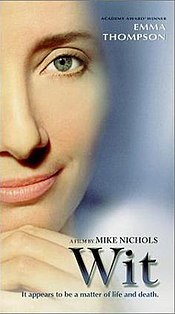 Wit, a 2001 HBO movie starring Emma Thompson, has never really made much of an impression on the viewing public in the
To be sure, Wit makes for anything but comfortable viewing. Depicting the suffering of an English Literature professor diagnosed with ovarian cancer, the setting never departs from the hospital, and the plot, if such a word ought to be used, is minimalist. For most of the 99 minutes, all the viewer is presented with is Emma Thompson speaking directly to the camera about seventeenth-century poetry.
Despite this (or, perhaps, because of it), what emerges is an astounding dissection of the human mind under stress. For much of the film I could barely tear my eyes away from the screen, and it was the monologues, not the action, which most inescapably held my gaze.
Monday, 12 December 2011
One Day: A tentative literary analysis
Is literary analysis something that ought to be reserved for a particular type of book? It’s a significant question, because implicit in it is a questioning of the fundamental purpose of literary analysis. This is a debate that fascinates me, but rather than exploring it in the abstract, I want to take a work of incredibly popular modern fiction, and subject it to some serious, if tentative, analysis. The book I want to take is One Day by David Nicholls: it is well on its way to reaching one million sales this year in the UK
The originality of the book is chiefly found in this unique structure: the book follows the lives of protagonists Emma and Dexter on the same date across 20 years. Nicholls himself said that he wanted to create the sense of ‘a photo album, so that the characters seem to change, yet remain the same’. However this snapshot approach is undermined by the fact that (as critical reviewers have pointed out) each chapter tends to begin with each character recounting what has happened in the preceding twelve months.
A second claim Nicholls makes for his structure is that ‘my initial instinct was to cover landmarks – births, marriages, deaths. Instead, I’ve taken one day at random – like a date on a bank statement’. This is a radical claim: as early as Tom Jones in the eighteenth century novelists have been conscious of omitting insignificant passages in story; but Nicholls claims to be doing the opposite. This might be seen to be commenting on the significance of non-momentous events, except it seems that Nicholls is again being disingenuous. It stretches plausibility that Emma and Dexter not only meet on July 15th, but it also the date on which they fall out, reunite, launch their first prime time show, become romantically involved, not to mention the date that Emma dies. This is not a criticism of the novel; but it is a dismantling of the claim that the days are chosen ‘at random’.
If the structuring is neither rigorously followed nor realistic, it might be better seen as a system of imposing significance and meaning. This is clearly a motivation for any narrative: in telling a story we take orderless events and manipulate them into a narrative with causation, and ultimately meaning. In One Day this meaning comes significantly from the fetishisation of one particular date. The actual significance of the date changes: initially it is the anniversary of their first meeting, by the end of the novel (in an allusion to Tess of the D’Urbervilles) it has become the anniversary of Emma’s death. Looking at dates for patterns to signify providence is a pastime of Robinson Crusoe, but in One Day it is not the characters who carry out this work (neither Emma nor Dexter is ever explicitly aware that it is the anniversary of their meeting), but the novel itself which highlights this anniversary and endows it with significance.
However in many ways, what is most significant in the novel is not the date, but the lovers themselves. One Day is deeply entrenched in the cultural attitude towards romance that two people are ‘meant to be’. One Day takes the comparatively rare (although by no means unique) approach of dividing attention equally between both lovers: Pride and Prejudice is the story of Elizabeth Bennett with Mr Darcy as her love interest; One Day has no such primacy.
In contrast to the shared focus on Emma and Dexter, the novel furthers this effect by marginalising all other characters, and particularly romantic interests. By beginning emphatically with their first meeting and continuing by highlighting both of them, there is never the slightest possibility that Dexter will end up with Sylvie, even when he is in love with her.
It is striking that the novel indulges in endless counter-factual speculation about Emma and Dexter coming together sooner (what if Dexter had mailed the letter? What if Emma had answered the phone when she was on her first date with Ian?), there is a total absence of comparable exploration of the possibility of them finding love elsewhere. The sense that is created by all these effects is that Emma and Dexter could only ever end up together – the tragedy of the book is that it takes them both so long to realise this.
Of course, this analysis holds firm for the vast majority of the novel, but the closing chapters offer two distinct twists. Emma’s death is obviously integral to the meaning of the novel, but it is equally worth considering the fact that Nicholls’ avoids the conventional comic romantic ending by bringing his couple together with five years left to go. It has been often noted that fiction has endless courting couples but precious few happy marriages: traditional comedy (and modern rom-coms) tend to end with a wedding day. The two years that Emma and Dexter are married function as a demystification of the ‘happily-ever-after’ myth: their inability to conceive symbolises the ongoing problems in the happiest couples. Dexter’s conclusion that he is not ‘happyish’ but ‘happy’ is a validation of this lifestyle and of the novel’s premise that the pair are destined to be together, but it is no fairy tale.
Far more significantly, the fairy tale premise is undermined by the sudden death of Emma. Again, this might conventionally be placed at the very end of the novel, with perhaps the last chapter inserted as an epilogue, but Nicholls resists this temptation in order to consider what happens when a Romeo has to outlive his Juliet. Dexter, unlike Emma, has been prepared for this by undergoing significant loss twice in the novel; once when his mother dies and once with divorce: neither case ends well. Thus it is unsurprising when his most significant loss sees him thrown out of a strip club.
Of course, Dexter doesn’t end in self-destructive mode; he ends by taking his daughter to the spot where he spent that first day with Emma. This artistic symmetry only confirms the sense that he has no life beyond her: he is on holiday with his daughter from a pre-Emma relationship and his post-Emma partner, but his actions are still focused on her. Partly this is because it is the anniversary of her death, a day on which she would obviously be in his thoughts, but in the structure of the novel every day shares this focus. Dexter does not end the novel in despair, but he does end it with very little beyond memory to live for.
Thus One Day is both inextricable from and sceptical of the myth of lovers destined to be with one another. On the one hand there is no possibility in the novel that Emma could have married Ian or Dexter been happy with Sylvie, but on the other there is no possibility that Dexter will ever see Emma again. ‘Em and Dex’ is at once a mythologized concept (it is hard to finish the book without wondering who your Em/Dex is) and simultaneously extinct. Fragile but beautiful, One Day’s presentation of love is far more complex than the pop-fiction romantic comedy box in which it has been placed.
Let me know what you think in the comments!
Let me know what you think in the comments!
Monday, 29 August 2011
My new novel
So I was working on this just now, its very raw (probably to the point of spelling errors...), but it's the prologue to what might potentially become a novel. Or not. We shall see.
It's (hopefully) funny, but also quite dark, and features prolific swearing, but if that doesn't put you off you're clearly bored enough to keep reading, so go on. Feel free to let me know what you think, even if you don't make it the whole way through.
___________________________________________________________
“Yeah, but I didn’t steal them. I was just walking down High Street, you know, and then someone came out of the shop, it was this girl, she was like five foot tall, quite chubby, still fit though, and she was carrying this bag, like a handbag, and then she started running and these two guys came out, from security, and they were chasing her, so she suddenly lobbed them at me, and I didn’t even know what it was to be honest, but I caught them, and suddenly these guys were on me, and like they must have seen me catch them cos they were quite close, and one of them tried to deck me but he missed and then they pushed me over and ripped them off me, so I just lay there. I’m not gonna lie, it was pretty fucking scary, cos I’ve never been in trouble before, and I didn’t want my mum to find out, cos she reckons my girlfriend’s been a bad influence on me and she ain’t, but its not like she believes that… So yeah, I didn’t do it, so like, I don’t even know why I’m here, do you know what I mean?”
The balding, tubby, broad faced cop looked across the table. For a minute he just stared blankly, with the dead expression of an insomniac watching late night television. Then his left eyebrow slowly curved itself and climbed his glistening forehead.
“That is literally bollocks.”
His junior partner just barely held back a snort, before almost instantly rearranging his facial features to the mirror image of a concern and responsibility. Kevin started to open his mouth, but the tubby cop interrupted.
“That is fecking ridiculous.” (He wasn’t Irish, but like many Englishmen he sometimes forgot that in tense situations.) “You went into the shop, you picked up the sweets, you shoved it in your pocket, you walked out...”
“…No but you didn’t see that girl…”
“That girl? Of course I didn’t see that girl! Noone outside of the chubby chaser porn you watched this morning before breakfast saw that fecking girl! You took the ipod…”
“No but they punched me, and that’s definitely not…”
“Punched you? They asked you to stop for a second and you told them you had a fecking gun.”
“Yeah but I didn’t.”
“And I honestly don’t know if that’s because you’re a liar or because you’re genuinely stupid enough to believe it.”
Saturday, 6 August 2011
Why shouldn't we shop at Tesco?
Today's Guardian's Weekend Magazine led on a story about how 'across the country people are battling the relentless march of the 'Big Four''. Have the four horsemen of the Apocalypse come at last? Is there a nationwide movement to find 11 footballers good enough to beat Arsenal, Chelsea, Manchester United and Liverpool? No, the Guardian doesn't think we should shop in supermarkets.
The article itself tells a harrowing tale. According to one banner near a Norfolk village 'TESCO IS A PARASITE - it fastens on to healthy, vibrant market towns and KILLS them'. Valiant freedom (from supermarkets) fighters in Bristol have damaged an evil new Tesco store so badly that it had to close for a month, but still the monstrosity matches on. 'Once one of the Big Four has a town in its crosshairs, it can usually be assured of eventual success... Once planning permission has been granted and another supermarket goes up, the inevitable happens: local traders suffer, and many go out of business'.
Leaving aside the ridiculous metaphor that suggests big supermarkets want to shoot towns, the biggest problem with this narrative is that it totally overlooks the crucial step in the process. When Tesco opens in a town local traders do not 'inevitably' suffer and go out of business. There is no magical corporate voodoo whereby Jerry's Butchers down the road suddenly wakes up to find itself bankrupt. Instead, shoppers can choose to spend buy their food (or clothes, or life insurance) from the supermarket rather than the small business, and if they do the small business loses income.
The Guardian focuses on the suffering of small business owners in the article, and that is indeed one side of the debate. However what about the shoppers, who can now save 10% on their food bills across the year, and thus afford to give themselves a holiday? Or those who previously didn't have time to get the film they wanted to watch that night because they couldn't squeeze in a trip to the DVD shop and the food shop in the small window of time they had free, but now thanks to a late-opening superstore can settle down in front of Titanic and have some dinner too in the bargain.
You might argue that those are small and superficial benefits, and they don't compare to the loss to communities and companies that are the necessary cost of such comforts. But if the benefits are so small and the damage to the community so great, then why are enough people shopping in supermarkets to keep them running? If the anti-supermarket campaigners are right and the appearance of Sainsbury's in their town will ruin it, then they need only convince enough people of this truth (which they consider so obvious it is acceptable to cause criminal damage in defence of it) and the new superstore will be choked of custom and move away.
The other side of the equation is that small businesses can save themselves by providing products or services that are more attractive than what Tesco can offer. Even if they can't compete on price due to economies of scale, there is nothing to stop small businesses going the extra mile to provide superior products or superior customer service. Residents in these towns can support small businesses not by opposing the arrival of supermarkets and denying choice to those who want it, but by continuing to shop in their local butcher even though they could get a wider range of cheaper meat just down the road. Unfortunately, the facts would suggest that (in the main) they don't.
And what of the Guardian's other claim against supermarkets, that thanks to the heinous Town and Country Planning Act of 1990 they can 'swing the debate by offering to fund no end of sweeteners: libraries, public spaces, housing, even schools'(!) How immoral, Tesco unscrupulous sinks small businesses by resorting to such disgusting bribery.
Except, isn't the Guardian angry about closures to libraries, claiming they're a vital service to communities and education? Aren't we all aware of the great need for housing at the moment, and the corresponding need to ensure there are available public spaces? Didn't Tesco give over £9 million to schools in the UK last year, providing vital equipment that will only become more important in an era of cuts? Isn't the whole argument that Tesco comes to areas and destroys communities completely undermined by the fact that the Guardian are claiming that they buy their way to success by investing in precisely the same communities?
Of course it is unfortunate for a very hardworking shop-owner if they close down as a result of losing custom to a supermarket. But given that supermarkets also provide jobs, produce products that need workers to produce them and form an important part of the communities they find themselves in, it is simply ridiculous to describe Tesco as a sinister parasite. If you prefer to help local shops then noone is stopping you from doing so. Just don't try and claim the moral high ground if I'd much rather nip down to Asda.
Subscribe to:
Posts (Atom)